
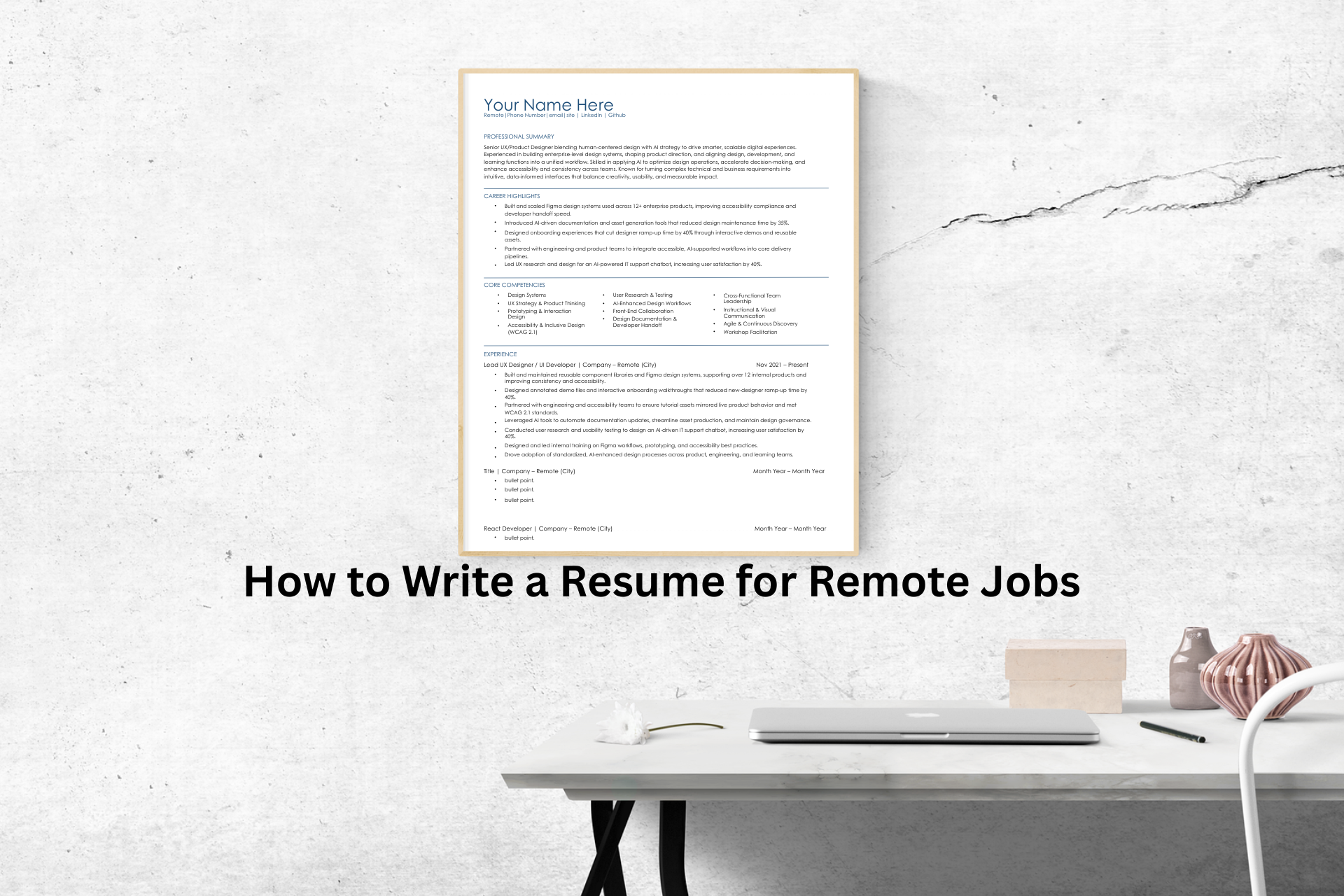
If you’re applying for remote jobs and hearing nothing back, your resume might be the problem.
That was true for me.
My resume was not terrible. It listed my experience, my skills, and my education. It had helped me get interviews before.
But when I started applying for remote jobs, everything changed.
Silence.
I spent months sending out applications and hearing nothing back. No interviews. No traction. Just a growing suspicion that maybe remote work was for other people, people with more experience, more connections, or a stronger background than mine.
But the real problem was not my experience.
It was how I was presenting it.
If you are trying to figure out how to write a resume for remote jobs, here is what I changed and why it made a difference.
Why a Regular Resume Does Not Always Work for Remote Jobs
One of the biggest mistakes job seekers make is assuming that a resume that works for in-office roles will automatically work for remote roles.
It usually does not.
A strong remote work resume needs to do more than prove you can do the job.
It needs to show that you can do the job without constant supervision, and that you can communicate, prioritize, and follow through in a remote environment.
Remote employers want to know that you can:
- work independently
- communicate clearly
- manage your time and priorities
- collaborate across teams
- deliver results without hand-holding
My old resume did not show any of that.
It listed responsibilities, but it did not signal remote readiness.
That is a big difference.
What a Resume for Remote Jobs Needs to Show
Before rewriting your resume for remote work, it helps to understand what hiring managers are actually scanning for.
A good resume for remote work should make it easy to see that you can:
Work Independently
Remote employers want to know you can own your work and move projects forward without someone constantly checking in.
Communicate Clearly
Because so much remote work happens in writing, your resume should reflect strong communication and collaboration.
Stay Organized
A good remote employee can manage deadlines, priorities, and responsibilities without a lot of external structure.
Deliver Results
At the end of the day, remote employers care about output. Your resume should show what you achieved, not just what you were assigned.
Once I understood that, I rewrote my resume with those signals in mind. A strong resume for remote jobs needs to show independence, communication, and results.
How to Improve Your Resume for Remote Jobs
Here are the five biggest changes I made to build a stronger remote job resume.
1. I Focused on Results Instead of Responsibilities
This was the biggest change.
Before, my bullet points described tasks.
Before:
Responsible for UI development and working with the design team.
That tells a hiring manager what I did, but not why it mattered.
After, I rewrote my bullets to focus on outcomes.
After:
Redesigned checkout flow that increased conversions by 23%, collaborating async with a distributed design team.
That one bullet does much more work.
It shows:
- the result
- the impact
- the ability to collaborate remotely
If you want a resume that gets remote job interviews, lead with outcomes whenever possible.
Ask yourself:
- What improved because of my work?
- What did I help increase, reduce, launch, fix, or streamline?
- What result can I quantify?
If your resume for remote jobs is too task-focused, it may be hurting your chances.
2. I Used Remote-Friendly Language
Once I started reading remote job descriptions more carefully, I noticed the same types of language showing up again and again.
Things like:
- self-directed
- async communication
- distributed team
- remote collaboration
- cross-functional work
- independent ownership
So I looked for places in my own experience where those phrases were actually true and made them visible.
That matters because a resume for remote jobs should not just say you are qualified. It should show that you already work in ways that support remote success.
If you have ever:
- worked from home
- managed your own schedule
- collaborated in different time zones
- used Slack, Zoom, Notion, Trello, Asana, or similar tools
- completed work independently
that counts.
You do not need to invent remote experience.
You need to frame your experience in a way that makes remote-readiness obvious.
3. I Cleaned Up the Formatting
My old resume was too dense.
Too much text.
Too little white space.
Too many words doing too little work.
So I simplified it.
I used:
- shorter bullet points
- clearer spacing
- cleaner section breaks
- only the most relevant experience for the roles I wanted
A good remote work resume should be easy to scan on a screen.
Hiring managers do not want to work hard to understand your value. If your resume feels cluttered, confusing, or too long, it becomes easier to skip.
A cleaner layout makes your experience easier to trust.
The goal is to make your resume for remote jobs easier to scan and easier to trust.
4. I Made Independence Visible
This is one of the most important things a remote employer is looking for.
Your resume should answer the question:
Can this person be trusted to get work done without constant oversight?
So I started highlighting:
- projects I owned from start to finish
- times I took initiative
- work I delivered independently
- results I created without being micromanaged
If you have ever:
- solved a problem on your own
- improved a process
- led something
- handled a project independently
- took ownership without being asked
that belongs on your resume.
A strong resume for remote work should make independence visible, not implied.
5. I Added a Tools Section
This was a smaller change, but still useful.
Remote work runs on tools.
Slack, Zoom, Notion, Trello, Asana, Figma, Google Workspace, GitHub, Jira, and whatever is relevant to your field.
Including a tools section helps your remote job resume signal that you can step into a digital workflow without a long adjustment period.
Keep it simple.
One line is enough.
Only list tools you actually know.
Want a better resume for remote jobs?
Inside The Remote Job Search Kit, you’ll get a fill-in-the-blank remote-ready resume template, plus cover letter templates, a LinkedIn checklist, a job application tracker, and more.
Get The Remote Job Search Kit →
My Remote Work Resume Checklist
If you are updating your resume for remote jobs, make sure it includes these five things:
1. Results, Not Just Tasks
Focus on what changed because of your work.
2. Remote-Friendly Language
Use language that signals independence, ownership, collaboration, and async communication where it is true.
3. Clean Formatting
Make the resume easy to scan quickly.
4. Proof of Independence
Show that you can own projects and deliver without constant supervision.
5. Relevant Tools
List the collaboration and workflow tools you actually use.
What Happened After I Updated My Resume
Once I rewrote my resume, things started to change.
I also updated my LinkedIn around the same time, which helped support the same story.
A few weeks later, a recruiter found me on LinkedIn and reached out about a remote UI role.
Within three weeks, I had two job offers.
Was it only because of the resume?
No.
Mindset mattered.
LinkedIn mattered.
Strategy mattered.
But the resume helped get me in the door.
It gave recruiters and hiring managers a reason to take a closer look.
Do You Need a Cover Letter for Remote Jobs?
Honestly, I did not use cover letters for most of my own remote job search.
But there are situations where they matter.
A cover letter can help if:
- the company specifically asks for one
- you are changing careers
- you are pivoting into remote work for the first time
- you need to explain part of your story
If your time is limited, I would still prioritize your resume for remote jobs and your LinkedIn profile first.
That is where I saw the biggest return.
Want a Remote-Ready Resume Template?
I turned the resume format I used into a fill-in-the-blank remote-ready resume template.
Inside, you’ll get:
- the exact structure I used
- prompts for writing stronger bullet points
- remote-friendly language suggestions
- a clean, ATS-friendly format
It’s included inside The Remote Job Search Kit, along with:
- cover letter templates
- a LinkedIn checklist
- a job application tracker
- a curated list of remote job boards
[Get The Remote Job Search Kit →]
Not Ready for the Full Kit?
Start with the free 7-Day Remote Job Reset.
It’s a short guide to help you get unstuck, reset your approach, and build momentum in your job search.
Get the Free 7-Day Remote Job Reset →
Final Thoughts on Writing a Resume for Remote Work
If you are applying for remote jobs and not hearing back, it does not automatically mean you are unqualified.
Sometimes it means your resume is telling the wrong story.
A strong remote work resume should not just list your experience.
It should show that you can:
- work independently
- communicate clearly
- stay organized
- deliver results
- thrive in a remote environment
You probably already have more of those skills than you think.
Now the goal is to put them on paper in a way that makes someone else believe it too.